
 5 min read
What citizen science is
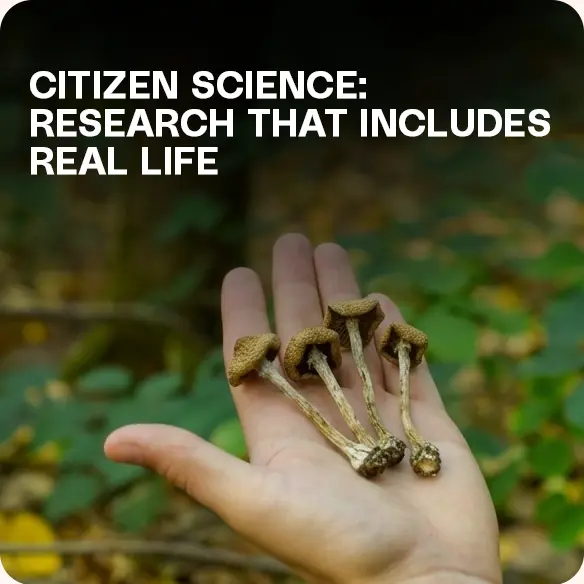
Citizen science is public participation in research. It’s when everyday people help build knowledge by tracking, observing, and reporting what they experience in a consistent way. Sometimes that looks like answering a short recurring question. Sometimes it’s logging changes over weeks or months.
It doesn’t replace clinical trials or traditional studies. It sits alongside them by lowering the barrier to collecting information: it’s often cheaper, faster, and less restrictive than running a formal study. The downside is that the data can be skewed, and conclusions may be less credible without careful design and validation.
How it’s changing the way we study
Citizen science is making real contributions to psychedelic research, especially in areas where traditional clinical trials run into familiar roadblocks: high costs, heavy regulatory requirements, small participant pools, and the difficulty of capturing how people use psychedelics in everyday life.
One of the clearest examples is the “self-blinding” method used to study psychedelic microdosing, which usually means taking very small, sub-perceptual doses of substances like LSD or psilocybin. People often try microdosing for reasons like mood support, creativity, or mental health, but studying it in a conventional trial setting is expensive and hard to scale. In a well-known 2021 study led by researchers at Imperial College London and supported by the Beckley Foundation, hundreds of self-identified microdosers participated remotely. Participants followed online instructions that helped them add placebo controls into their routines without clinical supervision, including tools like barcoded capsules to keep the process blinded. The design created placebo-controlled conditions in a relatively large sample (191 completers), making it one of the largest controlled microdosing studies to date, and it was done at a fraction of the cost of a lab-based trial. The findings were mixed in an important way: people reported improvements such as mood changes, but the results also showed how strongly expectations and placebo effects can shape what participants perceive.
Other projects take a more observational approach by focusing on large-scale tracking over time. Platforms like Microdose.me and the Quantified Citizen app, which has been associated with the Beckley Foundation, have enabled thousands of microdosers worldwide to log experiences, mood, cognition, and mental health measures over longer periods. While this kind of data cannot prove cause and effect, it can reveal patterns in how people use microdosing, what motivates them, and what benefits or downsides they report. It also helps round out the picture alongside smaller, tightly controlled clinical studies.
Citizen science has also driven practical innovation through patient communities. Clusterbusters, a patient-led network focused on cluster headaches, has helped develop community protocols around psychedelic use through shared self-experimentation and ongoing dosing discussions. Even without formal labs or institutional support, that collective knowledge-sharing has influenced how people talk about psychedelics for specific conditions and has helped shape what researchers consider worth investigating more formally.
Community spaces can contribute in a similar, indirect way by giving people a place to compare notes and surface common questions. In Microdosify Spaces, for example, members discuss routines, challenges, and outcomes over time in a moderated setting. It is not a clinical study, but it can highlight recurring themes and questions that may be worth studying with more rigorous methods.
Overall, citizen science helps democratize psychedelic research by using global communities, online tools, and self-tracking to generate larger and more diverse datasets quickly and at lower cost. It can narrow the gap between isolated anecdotes and stronger evidence, inform future study designs, and push the conversation forward on topics like microdosing, placebo effects, and therapeutic applications. At the same time, it keeps one reality front and center: expectations, context, and “set and setting” can strongly shape psychedelic outcomes, so interpreting results responsibly matters.
Why it matters and the benefits
Wellness doesn’t happen in a vacuum. Sleep, stress, routines, diet, and consistency all shape outcomes, and citizen science can reflect that “real world” messiness.
Done well, it can:
- capture long-term changes that are hard to measure in short studies
- include a wider range of lived experiences.
- reveal common themes and recurring challenges.
- help people feel more connected to the learning process.
It also has limits. People interpret questions differently. Participation is self-selected. Without controls, it can’t prove cause and effect. The honest role of citizen science is to spot trends and guide better questions, not to make medical claims.
What we’re doing at Microdosify
From time to time, we include a short, recurring question in our emails and on our website. It’s optional, and it’s meant to stay simple.
We’re not looking for perfect data or scientific language. We use responses to understand what people are noticing, what topics feel confusing, and what kind of support is actually helpful. That feedback helps us shape our educational resources, community discussions, products, services, and support content in a way that stays grounded in real experience.